





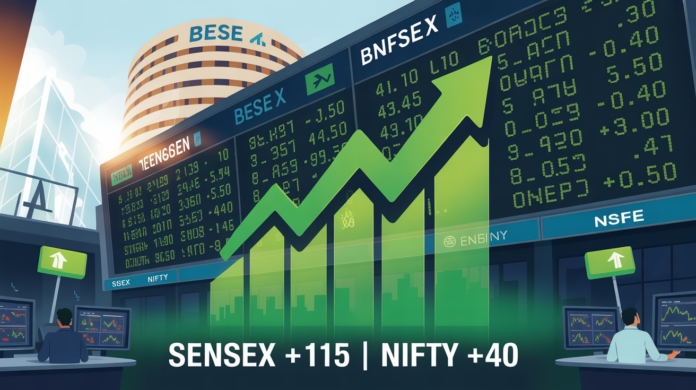

Indian equity benchmarks opened higher in early trade on Wednesday, December 24, tracking firm global cues and sustained buying by domestic institutional investors. Positive sentiment across Asian markets and policy support from the Reserve Bank of India also lifted investor confidence at the opening bell.
The 30-share BSE Sensex rose 115.8 points to trade at 85,640.64, while the broader NSE Nifty climbed 40.7 points to 26,217.85 in early deals. The gains reflected a cautious but optimistic mood as markets head into the final trading days of 2025.
Heavyweights Lead Early Gains
Several frontline stocks supported the benchmark indices during early trade. Bajaj Finance, NTPC, Trent, Bharat Electronics, Adani Ports, and Eternal emerged as the top gainers among Sensex constituents. Buying interest in banking, infrastructure, and defence-linked stocks helped offset weakness in the IT and healthcare sectors.
On the downside, technology and pharmaceutical stocks lagged. Tech Mahindra, Infosys, HCL Technologies, and Sun Pharma traded lower, limiting sharper upside in the indices. Analysts attributed the pressure on IT stocks to cautious global demand outlooks and selective profit-booking after recent gains.
Positive Global Cues Support Sentiment
Global markets provided supportive cues for domestic equities. Major Asian indices traded in positive territory during early hours. South Korea’s Kospi, Japan’s Nikkei 225, China’s Shanghai Composite, and Hong Kong’s Hang Seng all posted gains, reflecting improved risk appetite among investors.
U.S. equity markets also ended higher overnight on Tuesday. Wall Street’s positive close boosted sentiment in Asian trading sessions, encouraging investors to take selective exposure in equities ahead of the holiday-shortened trading week.
Market participants said global stability and easing concerns over near-term monetary tightening helped improve sentiment across regions.
Market Nears Year-End Consolidation Phase
Market experts believe Indian equities are entering a consolidation phase with an upward bias as the year draws to a close. V.K. Vijayakumar, Chief Investment Strategist at Geojit Investments Limited, said strong domestic fundamentals continue to support the market.
“As 2025 draws to a close, the market appears to be moving into a consolidation phase with a positive bias,” Vijayakumar said. He added that expectations of steady earnings growth in the third and fourth quarters of FY26, as well as into FY27, remain key drivers.
According to him, strong domestic macroeconomic conditions and consistent inflows from domestic investors have imparted resilience to Indian markets, even amid intermittent global uncertainties.
RBI Liquidity Measures Boost Banking Stocks
Investor sentiment also improved following the Reserve Bank of India’s latest liquidity-enhancing measures. On Tuesday, the RBI announced it would conduct open market operations worth ₹2 lakh crore to purchase government securities. In addition, the central bank said it would carry out a $10 billion buy/sell dollar-rupee swap auction.
These measures aim to inject liquidity into the banking system and ensure orderly market conditions. The RBI said the OMO purchases and swap auctions will take place between December 29, 2025, and January 22, 2026.
Vijayakumar said the additional liquidity would help bring down bond yields and support credit growth. “This is positive for banking stocks and the broader financial sector,” he noted.
The latest announcement follows the RBI’s earlier liquidity actions, including ₹1 lakh crore worth of government securities purchases and a $5 billion USD/INR swap auction conducted earlier this month.
FIIs Remain Sellers, DIIs Continue Buying
Despite the early gains, foreign institutional investors continued to remain cautious. Exchange data showed that FIIs sold equities worth ₹1,794.80 crore on Tuesday. In contrast, domestic institutional investors remained strong buyers, purchasing shares worth ₹3,812.37 crore.
Market analysts said the divergence between foreign and domestic flows continues to shape market behaviour. While foreign investors may use rallies to book profits, strong domestic participation has helped limit downside risks.
“Sustained domestic inflows and consistent DII buying are providing stability to the market,” Vijayakumar said. However, he cautioned that heavy selling by foreign investors could cap sharp upside moves in the near term.
Oil Prices and Other Indicators
Brent crude oil, the global benchmark, traded marginally higher at $62.39 per barrel, up 0.02 percent. Stable oil prices helped ease concerns over inflationary pressures and supported sentiment in energy-importing economies like India.
Currency and bond markets remained relatively steady, with investors closely monitoring global developments and central bank signals ahead of the new year.
Previous Session Recap
In the previous session on Tuesday, the Sensex snapped a two-day winning streak and closed marginally lower. The index slipped 42.64 points, or 0.05 percent, to end at 85,524.84. The Nifty, however, managed to close slightly higher, gaining 4.75 points, or 0.02 percent, to settle at 26,177.15.
Analysts said the muted close reflected cautious positioning ahead of key global cues and the RBI’s liquidity announcement.
Outlook Remains Cautiously Optimistic
Looking ahead, market participants expect Indian equities to trade within a narrow range in the near term, with a positive bias supported by strong domestic fundamentals. Earnings expectations, liquidity conditions, and global market trends are likely to guide sentiment.
While sharp breakouts may remain limited due to foreign investor selling, experts believe India’s long-term growth story and policy support continue to make domestic equities attractive as the market heads into 2026.