





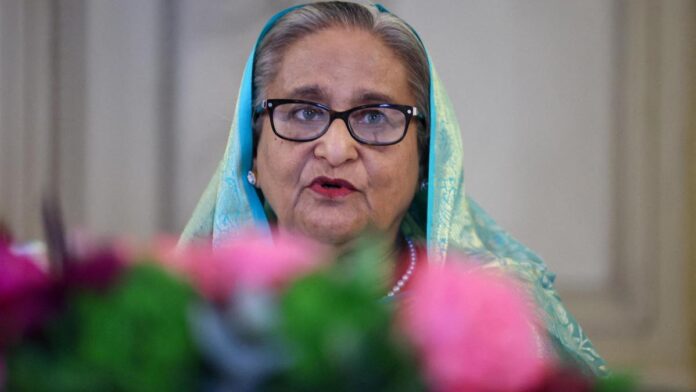

Former Bangladesh Prime Minister Sheikh Hasina has blamed the country’s interim government, led by Nobel laureate Muhammad Yunus, for the sharp decline in relations with India. She accused the administration of enabling extremist groups, issuing hostile statements against New Delhi, and failing to protect religious minorities during a period of growing violence and instability.
Hasina’s comments come amid rising concern in India over developments in Bangladesh. Recent incidents include the lynching of a Hindu man, attacks on media offices, and protests near Indian diplomatic missions. These events have triggered diplomatic interventions from New Delhi and raised questions about Bangladesh’s domestic stability and foreign policy direction under the interim regime.
Rising Violence Raises Diplomatic Concerns
The surge in violence has alarmed both domestic observers and regional partners. India, which shares deep political, economic, and security ties with Bangladesh, has expressed concern over threats issued by radical groups against Indian High Commissions and consulates.
Sheikh Hasina, who has been staying in India since her government was ousted last year following mass protests, said the current diplomatic strain did not emerge by chance. She described it as a direct consequence of the interim government’s actions and inaction.
“The strain you are witnessing is entirely of Yunus’ making,” Hasina said. She accused the administration of antagonising India while failing to ensure the safety of minorities and diplomatic establishments.
Allegations Against the Interim Administration
Hasina claimed that the Yunus-led government has allowed extremist forces to influence policy decisions, including foreign relations. She alleged that these groups operate without fear, target minorities, intimidate journalists, and organise demonstrations outside Indian diplomatic missions.
“His government issues hostile statements against India and fails to protect religious minorities,” she said. “It then acts surprised when tensions rise.”
She reiterated that India has stood by Bangladesh for decades. According to her, bilateral ties remain deep and resilient despite current disruptions.
“The depth of our relationship cannot be erased by a temporary government,” Hasina said.
She also accused the interim leadership of appointing radical elements to positions of power and releasing convicted terrorists from prison. She warned that such actions could pose serious risks to regional security.
“These are the same actors who marched on the Indian Embassy and attacked media offices,” she said. “A responsible government would protect diplomatic missions and prosecute those who issue threats. Instead, this regime grants immunity and glorifies violence.”
Diplomatic Exchanges Intensify
Hasina’s remarks follow a series of diplomatic exchanges between New Delhi and Dhaka. Earlier this week, India’s Ministry of External Affairs summoned the Bangladeshi envoy to express concern over threats to Indian personnel and missions.
Dhaka later summoned India’s High Commissioner. The interim government objected to what it described as “anti-election activities” by Bangladeshi political figures staying in India. Dhaka claimed these actions could influence Bangladesh’s parliamentary elections scheduled for February next year.
India rejected the allegations. Officials reiterated that New Delhi does not allow its territory to be used for activities that harm Bangladesh or its people. The Ministry of External Affairs reaffirmed India’s commitment to a stable, democratic, and inclusive Bangladesh.
Hasina Defends Long-Standing Partnership
Despite the tensions, Hasina stressed the long-term strength of India–Bangladesh relations. She said the partnership was built over decades and strengthened during her 15-year tenure.
“The ties between our nations are deep and fundamental,” she said. “They will outlast any interim arrangement.”
She added that once legitimate governance returns, Bangladesh will revive the practical and cooperative partnership developed during her time in office.
As Prime Minister, Hasina oversaw major advances in bilateral cooperation. These included agreements on connectivity, energy sharing, security coordination, and trade. Analysts note that current tensions mark a clear departure from that period of strategic alignment.
Protests, Killing, and Minority Safety
Tensions escalated further after the killing of Sharif Osman Hadi, a leader of the Inqilab Moncho movement. He was shot in Dhaka on December 12 and later died in Singapore on December 18. His death sparked widespread protests across Bangladesh.
Several protests turned openly hostile toward India. Demonstrators gathered outside Indian diplomatic missions, raising slogans and issuing threats. Indian authorities took note of anti-India remarks made by student leaders during these protests.
In response, New Delhi summoned the Bangladeshi envoy again to seek assurances on the safety of Indian missions and personnel.
Hasina linked Hadi’s killing to what she described as the collapse of law and order under the interim government.
“This tragic killing reflects the lawlessness that uprooted my government and has multiplied under Yunus,” she said.
She also flagged continued violence against religious minorities, particularly Hindus. She warned that such persecution damages Bangladesh’s social harmony and international credibility.
“When a government fails to maintain basic order, its credibility collapses,” Hasina said. “India sees the chaos and the erosion of everything we built together.”
Wider Regional Impact
Experts say the ongoing instability in Bangladesh carries broader implications for South Asia. Bangladesh plays a critical role in regional connectivity, trade routes, and security cooperation. Prolonged unrest could disrupt cross-border projects and strategic coordination.
For India, the situation presents a complex challenge. New Delhi must balance its support for democratic stability with the need to protect its diplomatic missions and citizens.
As Bangladesh approaches elections amid unrest and diplomatic strain, the coming months may prove decisive. The outcome will shape not only the country’s political future but also its relationship with key neighbours, especially India.