






US President Donald Trump has once again asserted that he played a decisive role in preventing a nuclear conflict between India and Pakistan during last year’s military escalation, adding a striking new detail: he claimed that Pakistan Prime Minister Shehbaz Sharif told him that as many as 35 million people could have died had the United States not intervened.
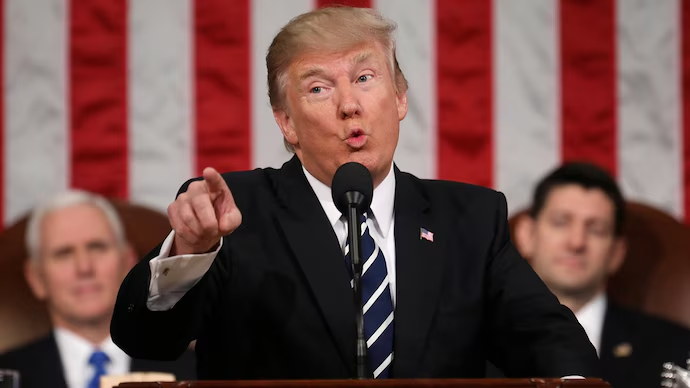
Speaking during his first State of the Union address of his second term, Trump said he had ended eight wars within his first 10 months back in office. Among them, he included what he described as a looming “nuclear war” between South Asia’s two nuclear-armed neighbors during India’s Operation Sindoor.
“Pakistan and India would have had a nuclear war,” Trump told lawmakers. “Thirty-five million people, said the Prime Minister of Pakistan, would have died if it were not for my involvement.”
The figure which he attributed directly to Sharif marked the first time Trump has publicly cited a casualty estimate allegedly conveyed to him by Pakistan’s leadership.
India Rejects Mediation Claim
India has consistently denied that any third-party intervention played a role in ending the four-day conflict that followed the April 22 terrorist attack in Pahalgam, in which 26 tourists were killed. In response to the attack, New Delhi launched Operation Sindoor on May 7, targeting what it described as terror infrastructure linked to Lashkar-e-Taiba and Jaish-e-Mohammed in Pakistan and Pakistan-occupied Kashmir.
According to the Indian government, the escalation concluded after Pakistan’s Director General of Military Operations (DGMO) contacted his Indian counterpart via an established military hotline, leading to what Foreign Secretary Vikram Misri described as a “ceasefire understanding.”
External Affairs Minister S. Jaishankar earlier dismissed suggestions of American mediation, remarking pointedly that the US “was in the United States” during the conflict.
New Delhi has long maintained that issues between India and Pakistan are strictly bilateral and has opposed internationalization of disputes related to Kashmir or cross-border terrorism.
Trump’s Broader Claims
In his address, Trump framed his actions within a broader narrative of global conflict resolution. He claimed credit for ending or preventing hostilities in eight international conflicts, including tensions involving Israel and Hamas, Israel and Iran, Serbia and Kosovo, Rwanda and the Democratic Republic of Congo, Armenia and Azerbaijan, and Cambodia and Thailand.
While he offered limited operational details, Trump characterized his approach as direct and forceful diplomacy that deterred escalation.
His remarks have reignited debate over the extent of US involvement in the India-Pakistan episode. No public documentation has surfaced confirming American mediation during Operation Sindoor, though diplomatic channels between Washington, New Delhi, and Islamabad remained active throughout the crisis, as is typical during major regional tensions.
Pakistan’s Position
Pakistan had previously credited Trump for what it described as a diplomatic role in preventing further escalation and had nominated him for the Nobel Peace Prize last year for his claimed intervention.
Trump’s new assertion that Sharif personally warned of 35 million potential deaths places Islamabad in an awkward position, particularly given that Pakistan has publicly emphasized both its military preparedness and the limited scope of the confrontation.
Pakistani officials have not issued immediate clarification regarding Trump’s specific casualty figure. Analysts note that while nuclear war scenarios between India and Pakistan have long been studied by defense experts, projections vary widely depending on the scale and duration of potential conflict.
Nuclear Risks in South Asia
India and Pakistan have fought multiple wars since 1947 and both possess nuclear arsenals. Security experts have often warned that even limited nuclear exchanges in South Asia could have catastrophic humanitarian and environmental consequences.
However, strategic analysts also point out that both countries maintain established communication channels and deterrence doctrines aimed at preventing uncontrolled escalation.
Operation Sindoor, while intense, was geographically targeted and time-bound. Military experts note that neither side officially signaled preparation for nuclear deployment during the confrontation.
Political and Diplomatic Implications
Trump’s renewed claim carries political overtones, particularly as he seeks to highlight foreign policy achievements early in his second term. By framing himself as a peacemaker in multiple regions, he reinforces a narrative of assertive American leadership.
For India, the statement is sensitive. Accepting third-party intervention would contradict its longstanding diplomatic principle that disputes with Pakistan are resolved bilaterally. For Pakistan, the reference to a 35 million death estimate may invite scrutiny regarding internal assessments during the crisis.
So far, neither New Delhi nor Islamabad has publicly corroborated Trump’s account of the conversation with Sharif.
As the diplomatic dust settles, the episode underscores the complex interplay between public political messaging and behind-the-scenes crisis management in nuclearized regions.