





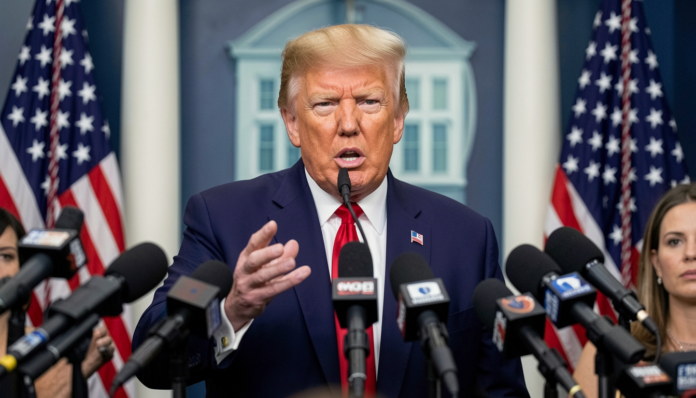

U.S. President Donald Trump sparked speculation about a possible shift in the ongoing Middle East standoff after claiming that Iran had given the United States a “very big present” linked to oil and gas developments around the Strait of Hormuz. The cryptic remark came as tensions surrounding the crucial maritime corridor showed tentative signs of easing following weeks of disruptions that sent global energy prices sharply higher.
Speaking to reporters at the White House, Trump described the development as a “tremendous” economic benefit for the United States but declined to reveal specifics. He emphasized that the “gift” was unrelated to Iran’s nuclear program and instead tied to energy dynamics. His comments came shortly after he postponed potential U.S. strikes on Iranian power plants and indicated renewed interest in negotiations to end the conflict.
“They did something yesterday that was amazing,” Trump told reporters. “They gave us a present, and it was a very big present worth a tremendous amount of money.”
When asked whether the development was connected to the Strait of Hormuz a narrow waterway through which roughly one-fifth of global oil supply moves Trump confirmed that it was.
The statement fueled speculation that Tehran may have signaled willingness to ease restrictions on shipping or reduce hostilities affecting tanker traffic. Since the conflict began in late February, disruptions around the Strait have rattled energy markets, slowed maritime movement, and increased insurance costs for vessels entering the Gulf.
Shortly after Trump’s remarks, signals emerged suggesting limited de-escalation. Iran, in a communication circulated through the International Maritime Organization, reportedly assured safe passage for “non-hostile” vessels transiting the Strait. While the assurance stopped short of a full reopening, it indicated a potential shift in Tehran’s posture toward commercial shipping.
The Strait of Hormuz connects the Persian Gulf to global markets and is considered one of the world’s most strategically important energy chokepoints. Any disruption can significantly affect oil and liquefied natural gas flows. In recent weeks, tanker traffic through the waterway had slowed dramatically amid security concerns, missile threats, and insurance complications.
Iran had earlier signaled it would restrict passage in response to U.S. and Israeli strikes, effectively tightening control over maritime movement. Though not formally declared closed, the operational impact was significant enough to halt most tanker activity. Shipping companies opted to delay voyages, while insurers raised premiums sharply.
Trump’s remarks also came amid renewed diplomatic maneuvering. The U.S. president said Washington was in talks with “the right people” in Tehran, suggesting backchannel communication may be underway. However, Iranian officials have publicly denied participating in truce-related negotiations.
The evolving situation follows Trump’s decision to delay potential military strikes on Iranian energy infrastructure by five days. The pause was framed as an opportunity for diplomacy, though both sides continue to exchange warnings. The delay also coincided with increased speculation about mediation efforts involving regional actors.
Shehbaz Sharif recently offered Islamabad’s assistance in facilitating dialogue. Pakistani officials indicated willingness to host talks aimed at reducing tensions. Reports suggested that American envoys, including senior diplomatic representatives, may explore indirect communication channels, though no formal negotiations have been confirmed.
Trump also suggested that leadership changes within Iran had altered the negotiating environment. He argued that the deaths of senior Iranian figures in earlier strikes created a different power structure in Tehran. While such claims remain contested, they reflect Washington’s view that diplomatic conditions may have shifted.
Meanwhile, energy markets continue to closely track developments around Hormuz. Even partial reopening of shipping lanes could ease pressure on oil prices and reduce volatility. Analysts note that any credible assurance of safe passage would likely stabilize tanker flows and lower insurance costs.
Despite the cautious optimism, uncertainty remains high. Iran’s commitment to allowing “non-hostile vessels” still leaves ambiguity about which ships qualify. Many shipping firms remain reluctant to resume full operations without clearer guarantees.
Trump reiterated that the development he described as a “gift” was tied to oil and gas rather than nuclear concessions. He also repeated claims that Iran had agreed not to pursue nuclear weapons, though no independent confirmation has emerged.
The remarks highlight the fluid nature of the standoff. Military threats, diplomatic overtures, and energy market dynamics continue to intersect. A sustained easing of tensions around the Strait of Hormuz could significantly influence global oil supply, inflation trends, and financial markets.
For now, Trump’s comments have added a new layer of intrigue. While details remain undisclosed, the suggestion of an energy-related “present” from Iran has fueled expectations that both sides may be inching toward limited de-escalation. Whether this translates into a broader ceasefire or merely a tactical pause remains unclear.
With shipping routes, energy markets, and geopolitical stability hanging in the balance, developments around the Strait of Hormuz are likely to remain closely watched in the days ahead.