





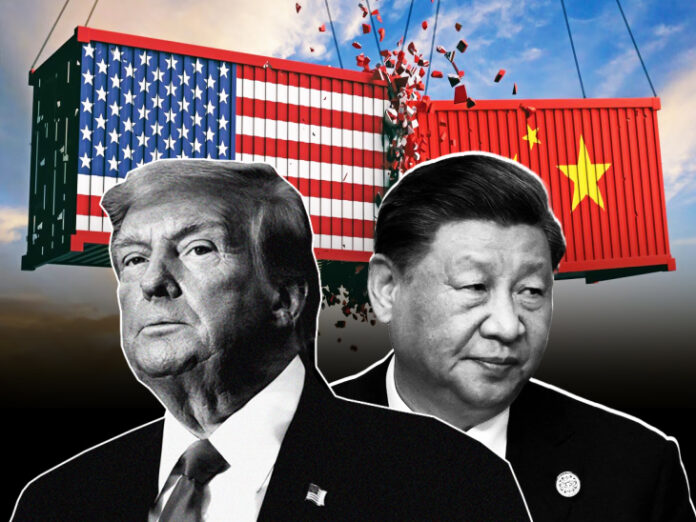

In an unexpected yet pragmatic turn, President Donald Trump has extended the U.S.–China trade truce for another 90 days, postponing a potential escalation between the world’s two largest economies.
The move, announced simultaneously in Washington and Beijing, averts—for now—the reimposition of punishing tariffs that could have taken the U.S. rate on Chinese imports from an already steep 30% to significantly higher levels, and prompted Beijing to retaliate in kind.
“All other elements of the Agreement will remain the same,” Trump wrote on Truth Social after signing the executive order.
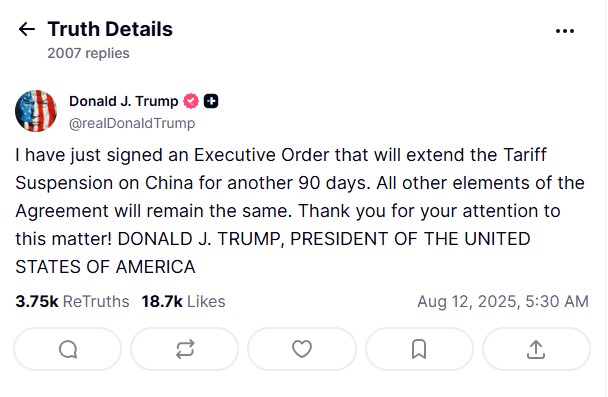
Beijing’s state news agency Xinhua confirmed the pause, framing it as an opportunity for continued dialogue.
A Breathing Space for Business
The extension was greeted with relief by American companies operating in China, which have been navigating years of tariff uncertainty. Sean Stein, president of the U.S.–China Business Council, called it “critical” for giving both sides space to work toward a deal that could expand U.S. market access in China and restore predictability for long-term investments.
At stake are issues ranging from fentanyl controls—with hopes of reducing U.S. tariffs in exchange for curbing precursor chemicals—to rekindling American agriculture and energy exports to China.
Tariffs as a Cudgel—and Their Limits
Trump’s trade doctrine has transformed the United States from one of the world’s most open markets into what critics call a protectionist fortress. According to Yale University’s Budget Lab, the average U.S. tariff has climbed from 2.5% to 18.6%, its highest level since 1933.
While other partners like the European Union and Japan accepted elevated U.S. tariffs in exchange for stability, China has been a more formidable counterpart—armed with its own leverage: rare earth minerals, critical for everything from electric vehicles to military aircraft.
In June, the two countries reached a limited easing: Washington agreed to loosen export restrictions on computer chip technology and ethane, while Beijing pledged to facilitate U.S. access to rare earths. Claire Reade, a former assistant U.S. trade representative for China affairs, put it bluntly:
“The U.S. has realized it does not have the upper hand.”
The Tariff Rollercoaster
Earlier this year, the confrontation nearly spiraled out of control. In May, triple-digit tariffs—as high as 145% on Chinese goods and 125% on American exports—brought trade to the brink of collapse and rattled global markets.
A hastily arranged meeting in Geneva saw both sides step back: U.S. tariffs dropped to 30%, China’s to 10%. Since then, the two nations have been in a holding pattern—talking, testing, and probing each other’s resolve.
Ali Wyne of the International Crisis Group argues that Washington overestimated the ability of steep tariffs to force concessions:
“The administration’s desire for a trade détente stems from the self-inflicted consequences of its earlier hubris.”
The Long War Ahead
Despite the current pause, the structural disputes remain. Washington’s key demands—stronger intellectual property protections, a rollback of industrial subsidies, and an end to practices that tilt global markets in Beijing’s favor—are far from resolved. Last year, the U.S. trade deficit with China stood at $262 billion.
Analysts like Jeff Moon expect only limited agreements in the near term—more soybean purchases, promises on fentanyl, and continued rare earth access. But the deeper issues, from technology competition to industrial policy, are unlikely to see a grand bargain anytime soon.
In other words, this 90-day reprieve is just another pause in what is becoming a long, grinding economic rivalry—a contest where tariffs are both a negotiating tool and a political symbol, and where neither side seems ready to concede the bigger game