





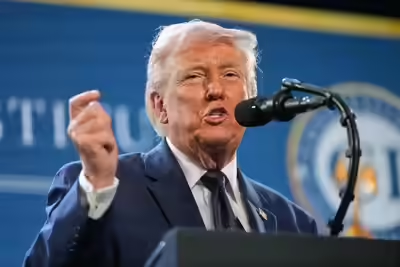

Donald Trump has never been one for diplomatic understatement. But even by his own standards, what he told the Financial Times on Sunday stopped the world mid-scroll.
“To be honest with you, my favourite thing is to take the oil in Iran,” the US President said, dismissing domestic critics of the idea as “stupid people.” He went further signalling that the United States was actively weighing a move to seize Kharg Island, Iran’s primary oil export terminal, through which the overwhelming bulk of Tehran’s crude revenues flow.
“Maybe we take Kharg Island, maybe we don’t. We have a lot of options,” Trump told the FT. “It would also mean we had to be there for a while.”
When asked whether Iran could put up a fight, his answer was characteristically blunt: “I don’t think they have any defence. We could take it very easily.”
The timing is not accidental. The US–Israel conflict with Iran has now entered its second month, and the battlefield is widening by the day. On Friday, an attack on a Saudi air base injured 12 American personnel and destroyed a US E-3 Sentry surveillance aircraft valued at $270 million. Simultaneously, Houthi forces in Yemen launched a ballistic missile toward Israel another front cracking open in an already combustible region.
On the economic front, Brent crude crossed $116 per barrel on Monday during Asian trading, nearing its highest point since the conflict erupted. The Strait of Hormuz through which roughly one-fifth of global oil supply moves remains severely choked, with shipping traffic down nearly 95 percent.
Into this pressure cooker, Trump has inserted the most explosive idea yet: don’t just win the war, take the oil.
The Pentagon has already been moving in this direction operationally. Around 10,000 troops trained for ground operations including seizing and holding territory have been ordered to the region. Approximately 3,500 personnel arrived on Friday, among them roughly 2,200 Marines. Thousands more from the 82nd Airborne Division are en route.
The military posture, combined with Trump’s public remarks, suggests Washington is at minimum using the Kharg Island scenario as maximum-pressure leverage and at maximum, is genuinely preparing for it.
Everyone who fills a fuel tank. Everyone who pays an electricity bill. Every government managing inflation. Every shipping company in the world.
Kharg Island handles the vast majority of Iran’s oil exports. If the US were to seize it or even credibly threaten to the consequences for global energy markets would be seismic. Oil prices, already elevated, could spike to levels not seen since the 2008 financial crisis. Emerging markets, including India, which depends heavily on Gulf crude, would face immediate and severe economic pain.
For India specifically, the stakes are layered. New Delhi has just secured safe passage through the Strait of Hormuz through quiet diplomacy with Tehran. Any US military operation targeting Kharg Island would instantly destabilise that arrangement and potentially draw India into an impossible diplomatic position caught between its energy dependence on the Gulf and its strategic relationship with Washington.
Globally, Trump’s Venezuela comparison is telling. He referenced US plans to retain indefinite control over Venezuela’s oil sector following the capture of Nicolás Maduro earlier this year. If Kharg Island follows that template, it would mark one of the most dramatic seizures of sovereign energy assets in modern history with consequences for international law, oil market governance, and the concept of resource sovereignty that would reverberate for decades.
Despite the aggressive public posture, Trump simultaneously confirmed that indirect US–Iran negotiations conducted through Pakistani intermediaries were continuing and “going very well.” He has set a hard deadline of April 6 for Tehran to agree to terms ending the conflict, or face further US strikes on Iranian energy infrastructure.
Iran’s new leadership, following the killing of Supreme Leader Ali Khamenei in early strikes, appears to be engaging cautiously. Trump claimed that Khamenei’s son and successor Mojtaba may be “dead or in extremely bad shape,” adding: “He’s gone. We’ve not heard from him at all.” Tehran, however, maintains that its leadership structure remains functional a claim it has repeated publicly even as Mojtaba’s continued absence from public view fuels speculation.
The April 6 deadline is now the fulcrum on which this entire crisis balances. If diplomacy holds, Kharg Island may remain a threat rather than a target. If it breaks down, the world could be watching the first US seizure of a hostile nation’s primary oil export terminal a move with no modern precedent and consequences that no one can fully model.
The oil is the prize. The question is whether anyone including Trump’s own advisors can stop him from reaching for it.