






Amid intensifying conflict in the Middle East and growing global economic anxiety, Donald Trump has indicated that the United States may soon scale back its military operations against Iran. The statement marks the clearest signal yet that Washington could be preparing to de-escalate a conflict that has already sent shockwaves through global energy markets and heightened geopolitical tensions.
In a post on Truth Social, Trump said the United States was “getting very close to meeting our objectives” and was actively considering “winding down” its military campaign in the region. The remarks come just weeks after hostilities escalated sharply on February 28, triggering a series of retaliatory strikes and counterattacks across the Gulf.
Reinforcing the administration’s stance, White House Press Secretary Karoline Leavitt stated that the Pentagon had initially projected a four- to six-week timeline to achieve its strategic goals. With the conflict now entering its third week, she claimed that US forces had made significant progress in weakening Iran’s operational capabilities.
“The Iranian regime’s ability to threaten the United States and its allies is being reduced day by day,” Leavitt noted, describing the military effort as both targeted and effective.
However, even as Washington hints at de-escalation, the situation on the ground remains volatile. Iran has launched a fresh wave of drone and missile strikes targeting key regional players, including Saudi Arabia and Israel. These attacks follow claims by Iran’s supreme leader Mojtaba Khamenei that the country had delivered a “dizzying blow” to its adversaries.
The conflict has increasingly spilled beyond bilateral confrontation, drawing in multiple countries and strategic assets. In Saudi Arabia, officials reported intercepting more than 20 Iranian drones in the eastern region, while Israel confirmed a new barrage of missiles launched from Iranian territory.
Tensions escalated further after strikes hit sensitive locations in Jerusalem’s Old City, an area of profound religious significance. Damage was reported near major sites, intensifying fears of a broader regional conflict. Meanwhile, Israeli forces launched retaliatory strikes on Beirut, targeting positions linked to the Iran-backed group Hezbollah.
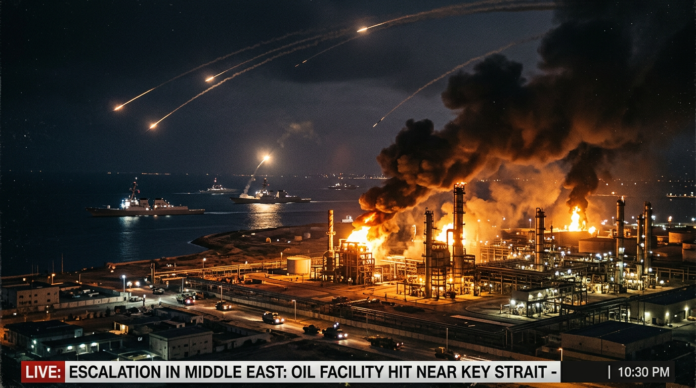
Energy infrastructure has also emerged as a critical flashpoint. Drone attacks on Kuwait’s Mina Al-Ahmadi refinery caused a fire, while Qatar’s Ras Laffan gas facility one of the world’s largest liquefied natural gas hubs was struck a day earlier. These incidents have heightened concerns about the vulnerability of global energy supply chains.
At the center of the crisis is the Strait of Hormuz, a vital maritime corridor through which nearly 20 percent of the world’s oil and gas flows. Iran’s effective blockade and continued threats to shipping routes have significantly disrupted supply, sending crude prices soaring and triggering volatility in financial markets.
In response to mounting economic pressure, the US administration has taken the unusual step of temporarily easing sanctions on Iranian oil exports. According to Scott Bessent, the move is designed to stabilize global supply by allowing the sale of approximately 140 million barrels of oil that had already been loaded onto vessels before March 20. The authorization is expected to remain in effect until April 19.
“Unlocking this existing supply will help ease short-term pressures on global energy markets,” Bessent said, acknowledging the broader economic implications of the conflict.
Despite these measures, oil prices continue to climb. Brent crude rose more than 3 percent on Friday, reflecting ongoing fears of prolonged supply disruptions. The surge has weighed heavily on global equities, with Wall Street closing lower amid concerns that sustained high energy costs could push the global economy toward recession.
Trump, however, struck a defiant tone when addressing reporters at the White House. Rejecting the idea of a ceasefire, he declared, “I think we have won,” arguing that negotiations were unnecessary given the current trajectory of the conflict. He also emphasized that the United States would not commit ground troops to the war, maintaining a strategy focused on air and naval operations.
In a controversial statement, Trump suggested that responsibility for securing the Strait of Hormuz should fall to other nations that depend on the route. “The United States does not need to be the primary guardian,” he said, though he added that Washington would assist if requested.
Diplomatic prospects remain uncertain. Trump indicated a willingness to engage in talks with Iran but claimed that the absence of key leadership figures has complicated communication. Iran’s leadership transition following the death of former supreme leader Ali Khamenei has added another layer of unpredictability to the situation.
Meanwhile, Iran’s leadership has projected confidence. In a statement marking Nowruz, the Persian New Year, Mojtaba Khamenei asserted that the country had effectively repelled its enemies and achieved a strategic victory.
As the conflict enters a critical phase, the possibility of de-escalation remains uncertain. While Washington signals readiness to wind down its military campaign, continued attacks and regional instability suggest that tensions are far from resolved. The coming weeks will likely determine whether diplomacy can prevail or if the crisis deepens further.