





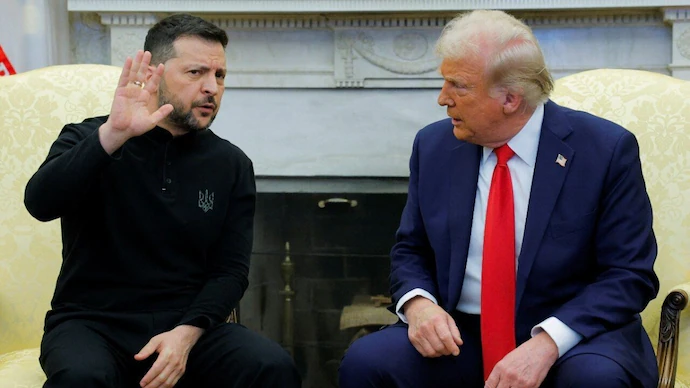

US President Donald Trump has adopted a firm and uncompromising stance ahead of his expected meeting with Ukrainian President Volodymyr Zelenskyy, making it clear that Kyiv’s latest peace push holds little value without Washington’s approval. His remarks underline the decisive influence the United States continues to exercise over any potential resolution to the Ukraine war and frame the upcoming talks as a test of Kyiv’s diplomatic leverage.
In an interview with Politico published on Friday, Trump said Zelenskyy does not command meaningful negotiating power unless the United States endorses his proposals. “He doesn’t have anything until I approve it,” Trump said. “So we’ll see what he’s got.” While blunt, the statement reflects Trump’s long-held belief that US backing remains central to shaping outcomes in global conflicts.
At the same time, Trump said he expects the meeting to be productive, suggesting that despite his skepticism, he remains open to hearing Zelenskyy’s case.
Zelenskyy Prepares to Present 20-Point Peace Framework
Zelenskyy is scheduled to meet Trump in Florida on Sunday, where he plans to unveil a newly drafted 20-point peace framework aimed at de-escalating the nearly three-year conflict with Russia. Ukrainian officials say the proposal includes the creation of a demilitarised zone in contested areas and seeks explicit US security guarantees to prevent future aggression.
The Ukrainian president has described the framework as “about 90% ready,” signalling that while the plan is largely finalised, Kyiv remains open to refinements during discussions with Washington. For Zelenskyy, securing American backing is critical not only for the credibility of the proposal but also for sustaining international support at a time when battlefield conditions and diplomatic fatigue pose growing challenges.
Trump, however, made clear that he will reserve judgment until he examines the details. His comments suggest that any endorsement will depend on whether the plan aligns with broader US strategic priorities, including relations with Russia and America’s role in global security.
Trump Signals Willingness to Engage Both Kyiv and Moscow
Trump also said he expects to speak with Russian President Vladimir Putin in the near future, reinforcing his belief that direct engagement with all parties is essential to ending the conflict. “I think it’s going to go good with him. I think it’s going to go good with Putin,” Trump said, adding that he plans to speak with the Russian leader “soon, as much as I want.”
The remarks highlight Trump’s confidence in personal diplomacy and his view that dialogue, rather than prolonged confrontation, offers the best path to peace. While supporters see this approach as pragmatic, critics argue that it risks sidelining Ukrainian concerns in favour of a great-power bargain.
Diplomatic Activity Intensifies Ahead of Florida Meeting
Zelenskyy has said diplomatic momentum around the war has increased in recent days. He recently described a conversation with US special envoy Steve Witkoff and Jared Kushner, Trump’s son-in-law, as positive, suggesting that both formal and informal channels remain active ahead of the high-profile talks.
The Ukrainian leader has positioned the Florida meeting as a chance to clarify Washington’s expectations and demonstrate Kyiv’s readiness for compromise without conceding core principles such as sovereignty and territorial integrity.
Trump Highlights Other Foreign Policy Moves
During the interview, Trump also addressed recent US airstrikes against ISIS targets in Nigeria, which he said followed the militant group’s killing of Christians. He revealed that he personally delayed the operation by a day for symbolic reasons.
“They were going to do it earlier,” Trump said. “And I said, ‘nope, let’s give a Christmas present.’ They didn’t think that was coming, but we hit them hard. Every camp got decimated.”
Trump also confirmed that Israeli Prime Minister Benjamin Netanyahu will visit him over the weekend, alongside Zelenskyy. “I have Zelenskyy and I have Bibi coming. They’re all coming,” Trump said. “They respect our country again,” he added, portraying the visits as a sign of renewed global engagement with the United States.
Security Guarantees at the Core of Ukraine’s Demands
For Zelenskyy, security guarantees from the United States will dominate the agenda. He has repeatedly argued that without firm assurances, any ceasefire risks collapsing under renewed Russian pressure. The Ukrainian leader said the talks may also touch on a possible economic agreement with the US, although he cautioned that no immediate breakthroughs are guaranteed.
“It’s difficult to say whether anything will be finalised by the end of the meeting,” Zelenskyy said, signalling a measured approach to expectations.
Territory and Europe’s Role in a Future Settlement
Territorial issues remain among the most contentious points. Russia controls most of the Luhansk region and about 70% of Donetsk, and continues to press Ukraine to surrender the remaining territory in the eastern Donbas. Kyiv has consistently rejected these demands.
However, Zelenskyy has recently indicated conditional flexibility. He said Ukraine could consider withdrawing troops from parts of its eastern industrial heartland if Russia reciprocates and the area becomes a demilitarised zone under international monitoring.
Zelenskyy also stressed that Europe must play a role in any lasting settlement. “We must, without doubt, find some format in the near future in which not only Ukraine and the US are present, but Europe is represented as well,” he said.
High Stakes Ahead
As the Florida talks approach, Trump’s remarks underline the power imbalance shaping the negotiations. Ukraine continues to seek security assurances and international backing, while the United States holds decisive influence over the direction of peace efforts. Whether Zelenskyy’s proposal can overcome Trump’s skepticism or whether Kyiv will need to rethink its strategy will become clearer after the weekend meeting.