





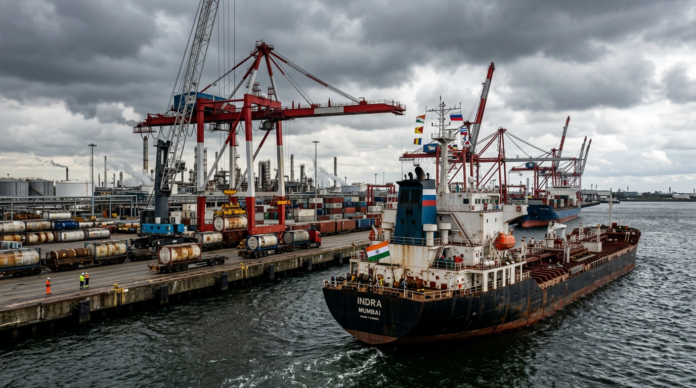

The United States has temporarily allowed India to resume purchases of Russian crude oil that is already stranded at sea, issuing a short-term waiver aimed at stabilizing global energy markets during a period of geopolitical turbulence.
The decision comes as international oil supply chains face increasing pressure due to escalating tensions in West Asia and concerns about disruptions to shipping routes near the Strait of Hormuz one of the world’s most critical oil transit corridors.
According to officials in Washington, the waiver permits Indian refiners to accept shipments of Russian oil that were already loaded on vessels before new restrictions were implemented. The temporary measure is expected to remain in effect for 30 days.
US Says Move Will Stabilise Oil Markets
US Treasury Secretary Scott Bessent described India as a “responsible partner” in managing global oil flows and said the waiver was intended to address short-term supply challenges rather than signal a shift in broader sanctions policy.
“The world is well supplied in oil,” Bessent said during a television interview. “We agreed to allow our allies in India to purchase Russian oil that was already on the water to ease temporary supply constraints.”
According to Bessent, India had earlier complied with Washington’s request to reduce purchases of sanctioned Russian crude.
“We had asked them to stop buying sanctioned Russian oil earlier this year, and they did. They were planning to substitute it with US crude,” he said.
Allowing India to process oil shipments already at sea, he added, would help prevent disruptions in the global energy market and reduce upward pressure on prices.
Floating Russian Oil Supplies
US officials noted that large volumes of Russian crude currently remain stored on tankers across global waters due to sanctions and shifting trade patterns.
Bessent estimated that hundreds of millions of barrels of sanctioned oil were effectively stranded at sea.
“If we unsanction some of those barrels temporarily, we can bring additional supply into the market,” he explained.
Energy analysts say this move could help moderate global oil prices in the short term by releasing oil that would otherwise remain unused.
Temporary Step, Not Policy Shift
Other officials in the Trump administration emphasized that the waiver should not be interpreted as a change in Washington’s broader stance toward Russian energy exports.
US Energy Secretary Chris Wright said the measure was designed as a limited intervention to ease market pressure during a volatile geopolitical moment.
“We are allowing our friends in India to take oil that is already loaded on ships and move it quickly into their refineries,” Wright said in a statement.
“This helps release supply into the market and reduces pressure on other refineries that might otherwise compete for the same barrels.”
He stressed that the step was temporary and intended solely to keep oil prices stable during the ongoing crisis.
Strait of Hormuz Tensions
The waiver comes amid mounting fears that the conflict in West Asia could disrupt shipments passing through the Strait of Hormuz, a narrow maritime chokepoint through which roughly one-fifth of the world’s oil supply travels each day.
Any disruption to traffic through the strait could have significant consequences for global energy markets.
US officials said the waiver forms part of a broader effort to ensure uninterrupted oil flows while policymakers monitor the evolving security situation in the region.
India’s Role in Global Energy Markets
India has become one of the world’s largest energy consumers and importers of crude oil, purchasing nearly 5.5 to 5.6 million barrels per day to meet domestic demand.
Around 90 percent of the country’s crude oil requirements are met through imports.
Over the past few years, India has significantly diversified its sources of crude supply, purchasing oil from producers across the Middle East, Russia, Africa, and the United States.
This diversification strategy has helped India maintain energy stability despite fluctuations in global markets.
Officials in New Delhi say the country’s oil supply position remains comfortable, even as geopolitical tensions persist.
Previous Tariffs and Trade Talks
The waiver also follows a period of diplomatic friction between Washington and New Delhi over India’s purchases of Russian oil.
Earlier this year, the United States imposed a 25 percent tariff on certain Indian imports, arguing that continued purchases of Russian crude were indirectly helping finance Moscow’s war in Ukraine.
However, those tariffs were later lifted after both countries reached a framework for an interim trade agreement.
Under that arrangement, India committed to gradually reducing its reliance on Russian crude while increasing imports of American energy supplies.
Strategic Energy Partnership
Energy cooperation has increasingly become a central pillar of the India-US strategic partnership.
Washington expects that India will continue expanding its purchases of American oil and liquefied natural gas in the coming years.
Bessent reiterated that the current waiver was only a short-term adjustment.
“This measure does not significantly benefit Russia financially,” he said. “It only allows transactions involving oil already stranded at sea.”
The US Treasury believes that allowing these shipments to move into Indian refineries will help stabilize global markets without undermining sanctions against Moscow.
As geopolitical tensions continue to reshape energy trade routes, the temporary waiver highlights how major economies are balancing political pressures with the need to maintain steady global energy supplies.