





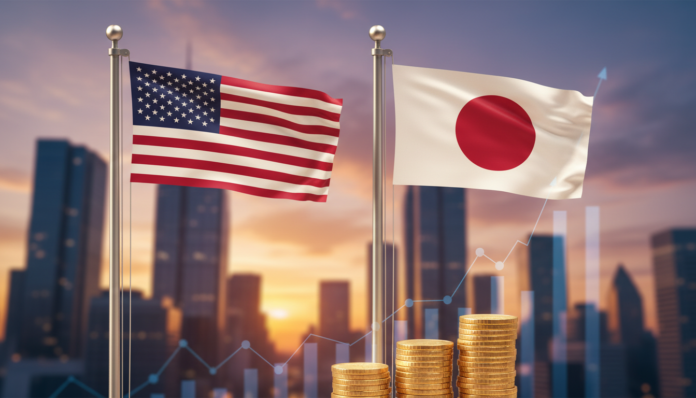

The United States and Japan have formalised a sweeping new trade and investment agreement that could reshape industrial cooperation between the two allies for years to come. Announced by US President Donald Trump, the deal includes a $550 billion investment commitment from Tokyo into the American economy, alongside tariff reductions and large-scale infrastructure projects spanning energy, manufacturing and critical minerals.
The White House described the pact as a “historic” step aimed at revitalising US industry, boosting exports and reinforcing economic security. While full financial structures are yet to be disclosed, officials confirmed that the first tranche of projects, valued at approximately $36 billion, has already been outlined.
Tariff Relief and Strategic Rebalancing
Under the agreement, the United States will reduce tariffs on Japanese imports to 15%, easing trade tensions that had escalated in recent years. Washington has repeatedly argued that tariff measures were necessary to correct trade imbalances and secure stronger investment commitments from allies.
President Trump framed the announcement as a breakthrough in economic diplomacy, stating that Japan is now moving forward with substantial capital commitments designed to strengthen America’s industrial base. The administration has positioned the deal as evidence that tariff leverage can yield tangible investment flows into domestic infrastructure and manufacturing.
For Tokyo, the agreement appears to reflect a broader strategy of deepening economic alignment with Washington amid rising geopolitical uncertainty in Asia and heightened competition in advanced manufacturing sectors.
Major Energy and Infrastructure Projects
Three large-scale investment projects were highlighted as initial components of the agreement.
The most prominent is a $33 billion natural gas-fired power plant in Portsmouth, Ohio. According to US Commerce Secretary Howard Lutnick, the facility will generate an estimated 9.2 gigawatts of electricity annually, potentially making it one of the largest natural gas-fired power stations in American history. Officials argue that the plant will strengthen baseload energy supply at a time when electricity demand is surging due to data centres, AI computing infrastructure and electrification trends.
The plant will reportedly be operated by SB Energy, a subsidiary of Japan’s SoftBank Group. The partnership underscores Japan’s growing role in financing US energy infrastructure tied to emerging technology demand.
A second project involves Japan’s participation in the $2.1 billion Texas GulfLink deepwater crude oil export terminal off the Texas coast. Developed by Sentinel Midstream, the terminal is expected to expand US crude export capacity significantly. Officials estimate the project could generate between $20 billion and $30 billion annually in additional export revenue once operational.
The third project focuses on establishing a synthetic industrial diamond manufacturing facility in Georgia, valued at approximately $600 million. The plant will be operated by Element Six, a unit of De Beers Group, and is intended to meet the entirety of US demand for synthetic diamond grit a critical material used in semiconductor production and advanced manufacturing. The initiative aims to reduce American reliance on foreign supply chains, particularly in sectors where China has held dominant positions.
Economic Security and Supply Chain Resilience
Beyond individual projects, the broader narrative surrounding the pact centres on supply chain resilience and national security. US officials have repeatedly emphasised reducing dependence on foreign suppliers for critical materials, energy capacity and advanced manufacturing inputs.
Japan’s commitment to invest heavily in US industrial infrastructure aligns with Washington’s push to secure strategic sectors domestically. At the same time, Tokyo benefits from expanded access to the US market and strengthened bilateral trade terms.
However, some financial details remain unclear. It has not been fully disclosed how much of the $550 billion commitment will be direct Japanese government-backed investment versus private-sector capital mobilisation. Additionally, under earlier bilateral frameworks, profit-sharing mechanisms initially split returns evenly before shifting more heavily in favour of the United States after initial investments are recouped.
Political and Strategic Context
The announcement follows recent meetings between Commerce Secretary Lutnick and Japan’s Economic and Trade Minister Ryosei Akazawa. Akazawa had previously indicated that certain issues remained unresolved before formal confirmation of the deal.
Analysts note that the pact arrives amid heightened global economic fragmentation, rising industrial policy competition and renewed focus on domestic manufacturing across advanced economies. For Washington, the agreement supports a broader industrial revival narrative. For Tokyo, it signals a commitment to preserving strong economic ties with its most critical security partner.
While critics may question the long-term cost-benefit balance and transparency of funding arrangements, the scale of the commitment underscores the depth of US–Japan economic interdependence.
If fully implemented, the deal could strengthen bilateral industrial collaboration in energy, semiconductors and advanced materials sectors widely viewed as foundational to future economic competitiveness.