





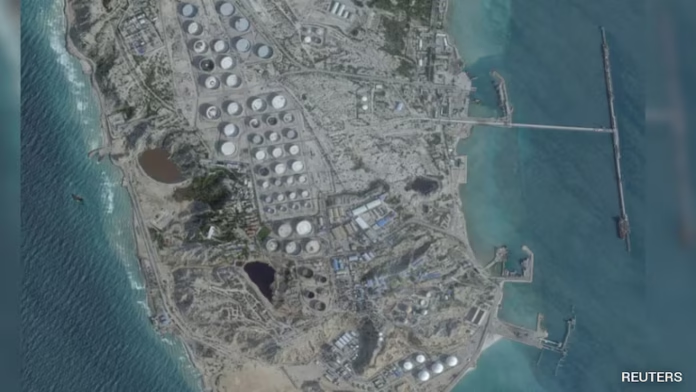

A recent United States military strike on Kharg Island, one of Iran’s most strategically important oil export terminals, has intensified tensions in the Middle East and raised fresh concerns about global energy security. The attack, which reportedly occurred amid the ongoing regional conflict, targeted a location often described as the backbone of Iran’s oil export system.
Often referred to as Iran’s “oil lifeline,” Kharg Island plays a pivotal role in the country’s economy, handling the majority of its crude oil shipments to international markets. Its strategic significance has made it a key focal point in the escalating confrontation involving the United States, Iran and regional allies.
A Small Island with Massive Energy Importance
Located in the northern part of the Persian Gulf, approximately 28 kilometres off the coast of Iran’s Bushehr province, Kharg Island covers just about 20 square kilometres. Despite its relatively small size, the island has an outsized role in the global oil supply chain.
Energy experts estimate that roughly 90 percent of Iran’s crude oil exports pass through facilities on the island. Large storage tanks, oil terminals and loading infrastructure allow supertankers to transport Iranian crude to buyers around the world.
The island’s importance stems largely from its ability to accommodate deep-water tankers, something many of Iran’s mainland coastal areas cannot easily support due to shallow waters.
Crude oil from several major offshore fields including Aboozar, Forouzan and Dorood is transported through an extensive network of subsea pipelines to processing facilities on the island. From there, the oil is stored in large tanks before being loaded onto export vessels.
Additional pipelines from some of Iran’s largest oil fields including Ahvaz, Marun and Gachsaran also connect directly to Kharg’s infrastructure. In total, the facilities are capable of handling hundreds of millions of barrels of crude oil annually, making the island a central node in Iran’s energy network.
Energy analyst Petras Katinas from the Royal United Services Institute noted that the island is vital not only for Iran’s economy but also for government revenue.
According to Katinas, losing control of Kharg Island would significantly disrupt Iran’s ability to fund state operations and maintain economic stability.
Historical and Cultural Significance
Beyond its industrial role, Kharg Island also carries historical and cultural importance. The island has long been a crossroads of civilizations and contains numerous archaeological sites and religious landmarks.
Among them is the 7th-century Mir Mohammad Shrine, a place of local religious significance. Other historic locations include ancient burial grounds associated with Zoroastrian traditions, Christian graves, and tombs dating back to the Sassanid Empire.
Remnants of a Dutch fort built in 1747 also remain on the island, reflecting the region’s long history of maritime trade and colonial influence.
Iranian writer Jalal Al-e-Ahmad once described Kharg as the “orphan pearl of the Persian Gulf,” a poetic reference to the island’s isolation yet immense importance.
Escalating Military Tensions
The reported strike on Kharg Island marks a major escalation in the conflict involving the United States and Iran. US President Donald Trump confirmed that American forces had conducted bombing operations targeting military installations on the island.
In a statement posted on social media, Trump said the attacks were aimed at military objectives but warned that further escalation could target the island’s oil infrastructure if Iran interferes with international shipping.
“I have chosen not to wipe out the oil infrastructure on the island,” Trump said, adding that such a step could be reconsidered if maritime traffic through the Strait of Hormuz is threatened.
The Strait of Hormuz is one of the world’s most critical energy corridors. Nearly 20 percent of global oil shipments pass through the narrow waterway each day, linking Persian Gulf producers with international markets.
Any disruption to shipping in the strait has immediate consequences for global energy prices and supply chains.
Global Oil Markets on Edge
The latest developments have already triggered volatility in international energy markets. Oil prices surged toward $100 per barrel amid fears that escalating conflict could disrupt supplies from the region.
Iran, which ranks among the largest oil producers within the Organization of the Petroleum Exporting Countries (OPEC), plays a significant role in global crude supply.
Iranian officials have warned that continued attacks on their energy infrastructure could prompt strong retaliation.
Iran’s parliament speaker Mohammad Bagher Qalibaf previously stated that Iran would abandon restraint if key national assets came under attack.
Analysts say potential Iranian responses could include targeting shipping lanes in the Strait of Hormuz or striking energy infrastructure across the region.
Financial institutions such as JP Morgan have warned that such scenarios could severely disrupt oil markets and trigger broader economic consequences.
Strategic Islands in the Persian Gulf
Kharg Island is not the only strategically important island in the Persian Gulf. Other Iranian islands such as Qeshm, Abu Musa, and the Greater and Lesser Tunb islands also hold significant geopolitical importance due to their proximity to shipping routes and energy infrastructure.
These islands form part of a broader network of strategic locations that influence maritime security and energy flows in the Gulf.
A Region on Edge
As tensions continue to rise, Kharg Island has emerged as a symbol of how energy infrastructure and geopolitics are deeply interconnected in the Middle East.
Any prolonged disruption to the island’s operations could have far-reaching consequences, not only for Iran but also for the global economy.
For now, the situation remains highly volatile, with international observers closely monitoring developments around one of the world’s most critical oil hubs.