





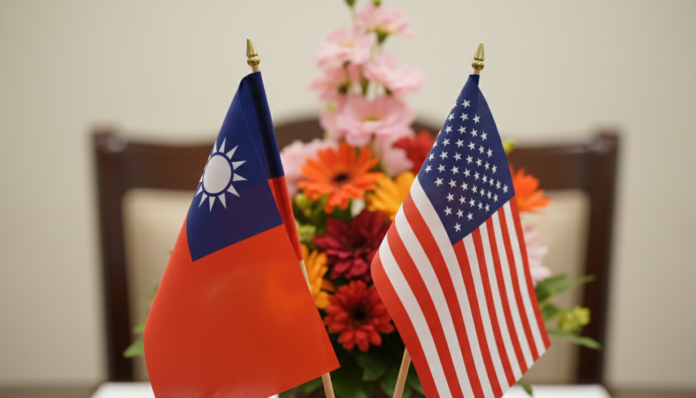

The United States and Taiwan have formalised a new trade agreement that reduces tariffs on Taiwanese exports to the US while expanding American access to Taiwan’s market, in a move both sides say will strengthen supply chains and deepen strategic economic ties.
Under the deal, Washington will lower duties on a wide range of Taiwanese goods from 20 per cent to 15 per cent. Taiwanese officials say the agreement also secures “Most Favoured Nation” (MFN) treatment for the island’s exports a status that ensures it will receive tariff rates no less favourable than those granted to other US trading partners.
The pact builds on a framework first outlined in January and now moves toward legislative review in Taiwan’s parliament, where it must be approved before taking effect.
Tariff Reductions and MFN Status
US Trade Representative Jamieson Greer said the agreement would reduce both tariff and non-tariff barriers affecting American exports to Taiwan, calling it a step that enhances long-standing commercial ties between the two economies.
Taiwanese Vice Premier Cheng Li-chiun described the outcome as improving the island’s competitive standing in global markets.
“Compared with our competitor countries, we have gained a relative advantage,” Cheng told reporters in Washington. “The gap created by previous free trade agreements has effectively been closed.”
According to Taipei, the deal lowers the average tariff burden on its exports to the US from an initial 15 per cent without layering reciprocal penalties to an effective average of about 12.33 per cent. Officials framed this as a meaningful recalibration rather than a symbolic cut.
For Taiwan’s export-driven economy, which is heavily integrated into global technology and semiconductor supply chains, even marginal tariff adjustments can influence cost structures and investment flows.
Expanded US Market Access
In exchange, Taiwan has agreed to reduce most of its own tariff barriers and provide preferential access to a broad range of American industrial and agricultural products.
A fact sheet released by the US Trade Representative’s office outlines Taiwan’s commitment to increase purchases of American goods through 2029. These include:
- $44.4 billion in liquefied natural gas (LNG) and crude oil
- $15.2 billion in civil aircraft and engines
- $25.2 billion in power equipment, electricity grid components, and related infrastructure
The agreement also signals Taiwan’s intent to drive a “long-term increase” in imports of important US goods, reinforcing energy and industrial interdependence.
American officials say the arrangement will help eliminate regulatory and technical barriers that have complicated US exports to Taiwan, particularly in agriculture and high-tech manufacturing inputs.
Focus on Technology and Supply Chain Resilience
Beyond tariff adjustments, the pact reflects broader strategic alignment. The United States has been working to diversify and fortify semiconductor and advanced manufacturing supply chains amid intensifying geopolitical competition.
Taiwan plays a central role in global chip production, and officials on both sides emphasised that the agreement would enhance resilience in high-technology sectors.
“This agreement builds on our longstanding economic and trade relationship with Taiwan and will significantly enhance the resilience of our supply chains, particularly in high-technology sectors,” Greer said in a statement.
For Taipei, closer economic integration with Washington carries both commercial and political significance. Securing MFN treatment and tariff reductions signals confidence in Taiwan’s role as a reliable trade partner.
Domestic Hurdles in Taiwan
Before implementation, the agreement must undergo review in Taiwan’s parliament, currently controlled by opposition lawmakers. Legislative scrutiny is expected to focus on tariff concessions, agricultural safeguards, and long-term fiscal implications.
Trade agreements have occasionally faced political resistance in Taiwan, particularly where domestic industries fear competitive pressure. However, the government argues that the benefits especially in technology and energy security outweigh short-term adjustments.
Vice Premier Cheng stressed that the deal places Taiwan on “fair footing” with competitors that have previously benefited from preferential trade arrangements with the US.
Strategic Context
The agreement comes at a time of heightened geopolitical tension in the Indo-Pacific. While the pact is framed primarily in economic terms, it reinforces strategic economic cooperation between Washington and Taipei.
By lowering tariffs and expanding trade flows, both sides aim to reduce dependence on third-party markets and strengthen bilateral investment.
Analysts note that while the 5-percentage-point tariff cut may appear modest, the cumulative value of energy, aviation, and infrastructure commitments makes the agreement economically substantial.
For American exporters, Taiwan represents a technologically advanced market with strong purchasing power. For Taiwan, securing predictable US market access supports its export-led growth model.
The Road Ahead
Implementation timelines will depend on Taiwan’s legislative process and regulatory adjustments on both sides. If ratified, the agreement is expected to take effect later this year.
Officials described the deal not as a final chapter, but as part of a broader trajectory toward deeper commercial engagement.
With tariffs reduced, MFN status confirmed, and significant procurement commitments in place, the US–Taiwan trade pact marks a tangible shift in economic relations one shaped as much by strategic alignment as by market arithmetic.