





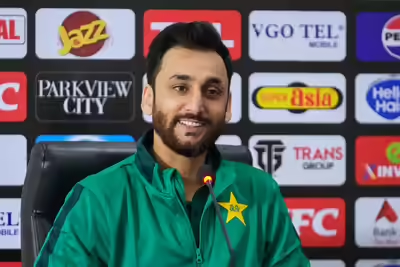

Pakistan captain Salman Ali Agha struck a confident and distinctly defiant note after his side registered a commanding 32-run victory over the United States in their ICC Men’s T20 World Cup Group A fixture, declaring that Pakistan’s willingness to chart its own path remains central to its cricketing identity.
Speaking after the win at the Sinhalese Sports Club, Agha emphasised that Pakistan’s strength lies not in imitation but in instinct. “We are Pakistan, we do things differently to the world,” he said, summing up both the mood in the dressing room and the philosophy he believes defines the team.
The victory not only boosted Pakistan’s campaign but also restored belief following earlier inconsistencies. With a high-stakes clash against India looming, Agha’s remarks were as much a statement of intent as a reflection on a clinical performance.
A Statement Win After Middle-Order Concerns
Pakistan’s win over the United States was built on a much-improved batting display, particularly through the middle overs an area that had drawn scrutiny in previous matches.
Agha acknowledged that the team had not executed well in that phase in their last outing, but credited the batting group for adapting. “Last game we didn’t bat well in the middle overs, but today we did. Once we got to 190, we knew we could defend that,” he said.
The captain’s assessment underlined a broader tactical shift a recognition that in modern T20 cricket, momentum through overs 7 to 15 can be decisive. By accelerating without reckless risk, Pakistan ensured they set a total that allowed their bowlers to operate with scoreboard pressure in their favour.
Preference for Setting Targets
Agha revealed that he would have opted to bat first regardless of the toss, underscoring his faith in Pakistan’s bowling unit. In his view, the team’s attack is capable of defending even moderate totals.
“With the kind of bowling we have, we know we can win even with 160–170,” he said.
That belief reflects confidence in Pakistan’s pace depth and variety, as well as their ability to exploit match situations. The bowling unit executed effectively against the United States, controlling the powerplay and striking at key moments to halt any chase momentum.
However, Agha was quick to stress that the side is not rigid in approach.
Flexibility as a Tactical Edge
While the captain prefers setting targets, he made it clear that adaptability remains central to Pakistan’s strategy. The batting order, he explained, has structural clarity at the top but flexibility beyond that.
“The first three will probably go in the same order, but after that we are flexible,” Agha noted, pointing to the presence of finishers who can either accelerate or consolidate depending on match conditions.
Such flexibility has become increasingly important in T20 cricket, where match-ups, pitch behaviour, and required run rates can shift rapidly. Pakistan’s ability to promote or hold back hitters gives them options particularly in high-pressure scenarios.
The captain also highlighted composure as a defining trait. Known for his calm demeanour, Agha appeared relaxed during the post-match presentation, even laughing when asked about his constant smile. “I always smile. When have you seen me not smile?” he quipped.
Yet beneath the light tone was a serious message about accountability and improvement.
Areas Still to Refine
Despite the convincing margin of victory, Agha did not present the performance as flawless. He identified the powerplay bowling as an area where greater precision is required.
“We like to bowl well in the powerplay. In patches we were good, but we can be more clinical,” he admitted.
That candid acknowledgment signals a leadership style grounded in realism. In tournaments as tightly contested as the T20 World Cup, marginal gains particularly in the first six overs often determine outcomes.
The India Factor
All eyes now turn to Pakistan’s upcoming encounter with India a fixture that transcends sport and carries immense emotional and competitive weight.
Agha’s assertion that Pakistan “does things differently” could be read as psychological positioning ahead of the showdown. Rather than framing the contest as pressure-laden, he appears intent on projecting self-assurance.
Pakistan–India clashes often hinge on temperament as much as talent. By reinforcing belief in the squad’s identity and approach, Agha is attempting to anchor his side in confidence rather than expectation.
Cricket analysts note that Pakistan’s unpredictability has historically been both a vulnerability and a strength. Under Agha’s stewardship, the aim seems to be harnessing that unpredictability into controlled aggression.
Leadership Under Spotlight
Agha’s comments suggest a captain keenly aware of narrative as well as nuance. His emphasis on individuality, adaptability, and continuous improvement reflects a team seeking balance between flair and structure.
With momentum building and the group stage intensifying, Pakistan’s path forward will test both strategy and nerve. For now, the captain has made his message unmistakable: identity first, fear second.
Whether that philosophy delivers against their fiercest rivals remains to be seen. But as the India clash approaches, Pakistan appear determined to define the terms on their own and, as their captain insists, to do things their way.