





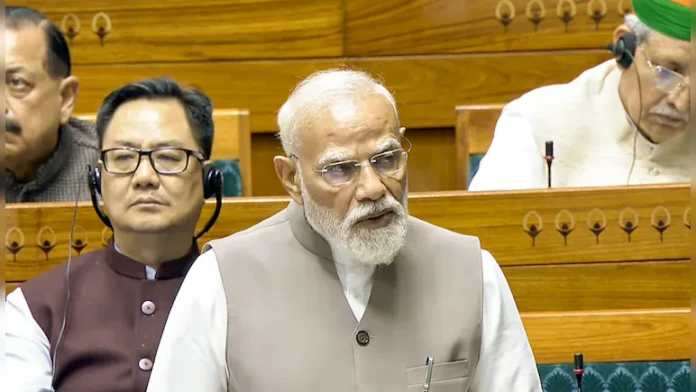

When Prime Minister Narendra Modi rose to address Parliament on Monday about the West Asia conflict, it was not a routine foreign policy briefing. It was a signal one carefully worded to tell multiple audiences, at home and abroad, that India was under real pressure and was taking it seriously.
The conflict has now persisted for over three weeks. What began as a regional war has evolved into something that directly threatens India’s energy supply, its trade arteries, and the safety of ten million of its own citizens living across the Gulf. The timing of Modi’s statement was not incidental. Parliament was in session, political pressure was building, and the economic data was becoming difficult to ignore.
The answer lies in the geography of India’s vulnerabilities.
The West Asia conflict did not just erupt in a distant corner of the world it erupted across the very corridor through which India’s economic lifeblood flows. A large share of India’s crude oil and natural gas is sourced from nations directly caught in this war. The shipping lanes through the Strait of Hormuz the narrow passage that connects Gulf oil fields to the rest of the world had become contested territory almost immediately after fighting broke out.
For the first two weeks, India managed largely through quiet diplomacy. But as the conflict entered its fourth week with no ceasefire in sight, the consequences began compounding. Cargo ships faced delays or detours. Fertiliser imports critical to Indian agriculture were at risk. Fuel costs were beginning to climb. And thousands of Indian crew members aboard commercial vessels in those waters were caught in an increasingly unsafe operating environment.
The tipping point appears to have been the Strait of Hormuz. Once ship movement through the strait became genuinely difficult, the government could no longer treat this as a situation to be managed behind closed doors. Parliament demanded accountability. Industries demanded answers. And the diaspora one crore Indians working across the Gulf deserved to know what their government was doing.
Modi’s statement, his first in Parliament since the conflict began, was the government’s formal acknowledgement that the situation had crossed from manageable inconvenience to a genuine national challenge.
The obvious answer is: most of India, in ways that are not always visible on a news ticker.
Every household that pays a cooking gas bill. Every farmer who depends on imported fertiliser. Every family with a relative working in Dubai, Riyadh, Muscat, or Kuwait. Every business that exports goods through Gulf shipping routes. The conflict’s economic reach into Indian daily life is wide, even if indirect.
Modi named the pressures plainly “unprecedented economic, national security, and humanitarian pressures.” That is unusually direct language for a Prime Minister known for calibrated messaging. It suggested the government wanted the public, and Parliament, to understand the gravity rather than be caught off guard by rising prices or disrupted supply chains.
Beyond domestic audiences, the statement was also aimed outward. India has been walking a careful line maintaining ties with Iran while avoiding antagonising the United States, which was separately pressing allies to join a naval coalition at the Strait of Hormuz. Foreign Minister S. Jaishankar had already signalled India’s preferred approach: bilateral talks with Tehran to secure ship passage, not participation in any military deployment.
Modi’s address reinforced that positioning India as a peace-seeking neutral, urging dialogue, protecting its own interests through diplomacy rather than alignment.
The short-term picture involves managing the flow of oil, gas, fertilisers, and ships. India has already secured some ground Iran permitted several Indian carriers to cross the strait, and Modi confirmed that multiple ships had safely returned home in recent days. The government says it is in continuous contact with international partners to keep maritime corridors open.
But the longer-term question is more complex: what happens if the conflict does not wind down quickly?
India’s crude import strategy will face stress. The government may need to accelerate efforts to diversify energy sourcing, expand strategic petroleum reserves, and renegotiate terms with suppliers outside the conflict zone. For the diaspora, evacuation contingencies which India has exercised before, as in Operation Kaveri may need to be updated.
Diplomatically, India will face increasing pressure to take a clearer stand as the war drags on and global coalitions harden. The room for studied neutrality tends to shrink the longer a conflict persists.
Modi closed his address with an appeal that was both political and moral: “It is essential that a united and unanimous voice goes out to the world from India’s Parliament on this crisis.” That unity, if it holds, gives India more diplomatic weight in the conversations ahead.
The conflict is not over. Its reach into Indian life is only growing. Monday’s address was not a conclusion it was the beginning of a harder conversation.