





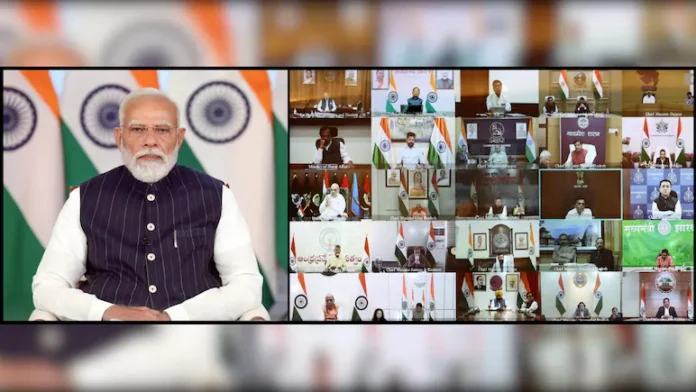

Prime Minister Narendra Modi on Monday chaired a virtual meeting with Chief Ministers and Lieutenant Governors of states and Union Territories, urging coordinated action to safeguard supply chains, energy security, and essential commodities as tensions in the Middle East threaten to disrupt global markets. Emphasising a united national response, he called on states to function as “Team India” and remain prepared for potential economic and logistical fallout.
The high-level review meeting, conducted via video conferencing, focused on assessing the implications of the ongoing Gulf crisis on India’s imports, fuel availability, fertiliser supplies, and broader economic stability. With India heavily dependent on energy imports from the region, the Centre is closely monitoring developments that could affect shipping routes, commodity prices, and trade flows.
The Prime Minister noted that the situation in the Middle East remains fluid and requires constant vigilance and adaptive strategies. He informed state leaders that an Inter-Ministerial Group has been conducting daily reviews since early March, tracking developments and recommending timely interventions to maintain stability. The government’s priorities, he said, include ensuring uninterrupted supply chains, protecting citizens’ interests, stabilising markets, and supporting industry.
The meeting comes amid rising geopolitical tensions in the Gulf region that have already triggered volatility in crude oil prices and concerns over shipping routes. Any disruption in the Strait of Hormuz or surrounding maritime corridors could significantly impact India, which imports a large share of its crude oil, liquefied natural gas, and fertilisers from the Middle East.
Officials fear that prolonged instability could lead to higher fuel prices, increased transportation costs, and supply constraints affecting agriculture and manufacturing. The upcoming Kharif sowing season adds urgency, as fertiliser availability and logistics become critical for farmers. The Centre is therefore seeking proactive coordination with states to prevent shortages and maintain price stability.
Drawing parallels with the COVID-19 pandemic response, the Prime Minister recalled how coordinated action between the Centre and states helped manage disruptions to supply chains and essential services. He stressed that similar collaboration would be required to navigate the current global uncertainty.
The Prime Minister urged states to ensure smooth functioning of supply chains and maintain strict vigilance against hoarding and profiteering. He directed state administrations to activate control rooms at both state and district levels to monitor stock availability and respond quickly to emerging challenges. Authorities were also asked to maintain administrative alertness to prevent panic buying and disruptions in essential commodities.
Special emphasis was placed on the agriculture sector. The Prime Minister asked states to monitor fertiliser storage, distribution, and availability to avoid difficulties for farmers ahead of the Kharif season. He said advance planning and real-time tracking would be necessary to ensure uninterrupted supply.
He also warned against misinformation and rumours, noting that panic-driven reactions could worsen market instability. States were advised to ensure timely dissemination of accurate information and to remain vigilant against online frauds and fake agents exploiting the situation.
Border and coastal states were asked to pay special attention to shipping operations, port logistics, and maritime supply lines. The Prime Minister also suggested that states with large numbers of citizens working in the Middle East activate helplines, appoint nodal officers, and set up district-level support systems to assist affected families.
The Centre is expected to continue daily monitoring of energy markets, logistics routes, and commodity supplies. States will begin activating control rooms and reviewing inventory levels of fuel, fertilisers, and essential goods. Additional coordination meetings may be held depending on developments in the Gulf region.
Defence Minister Rajnath Singh briefed participants on steps already taken, including measures to ensure LPG availability and adjustments in fuel-related taxes aimed at cushioning the impact of global price volatility. He said the government is prepared to take further steps if required.
Chief Ministers participating in the meeting informed the Prime Minister that the situation in their states remained stable, with adequate availability of petrol, diesel, and LPG. However, they agreed on the need for continued monitoring and coordination.
Authorities may also increase scrutiny of fuel distribution networks, fertiliser inventories, and logistics movement. Industry stakeholders are expected to be consulted to assess vulnerabilities in manufacturing supply chains.
The developments directly affect consumers, farmers, businesses, and Indian workers in the Middle East. Rising energy prices could influence transport costs and inflation, while fertiliser disruptions may impact agricultural output. Exporters and importers are also monitoring shipping routes and trade costs.
States with significant migrant populations in Gulf countries are preparing contingency support systems. Families of overseas workers could require assistance if travel disruptions or employment uncertainties emerge.
For businesses, especially manufacturing and logistics sectors, continuity of raw materials and fuel supplies remains a key concern. Economists say coordinated action between the Centre and states will be critical to maintaining economic stability.
The Prime Minister reiterated that India successfully managed previous crises through collective action and expressed confidence that the country would navigate the current situation effectively. He called for continuous communication, timely data sharing, and unified decision-making to ensure that essential supplies remain uninterrupted and markets stay stable.