






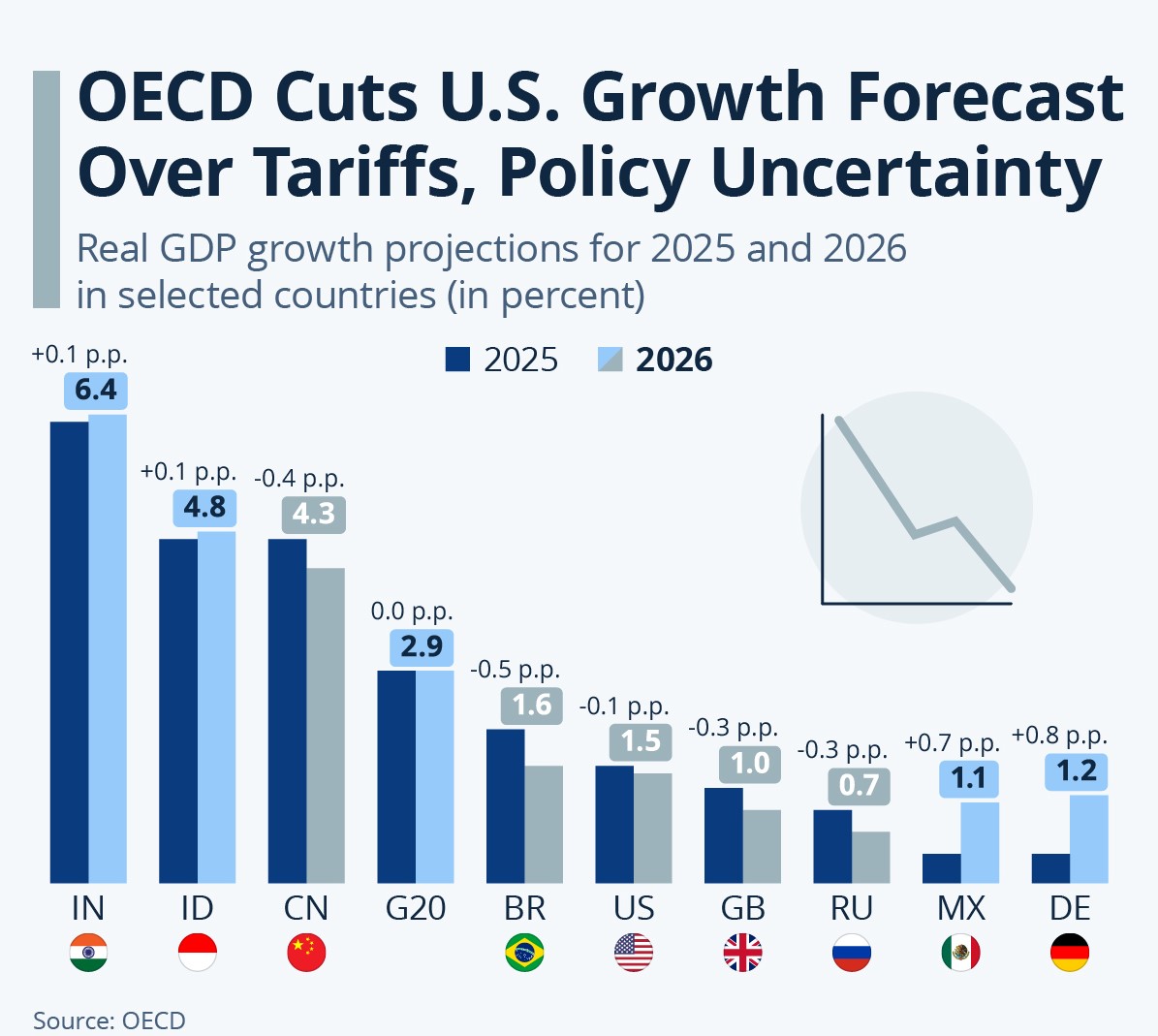
The world economy is expected to grow more slowly in the next two years, according to a new report by the Organisation for Economic Cooperation and Development (OECD). The OECD says that after growing 3.3% in 2024, the global economy will slow to 2.9% growth in 2025 and 2026.
The report points to several reasons for this slowdown:
-
More trade restrictions and tariffs
-
High interest rates are making borrowing more expensive
-
Lower confidence among businesses and customers
-
Uncertainty about government policies in many countries
U.S. Economy Set to Slow Down More Than Expected
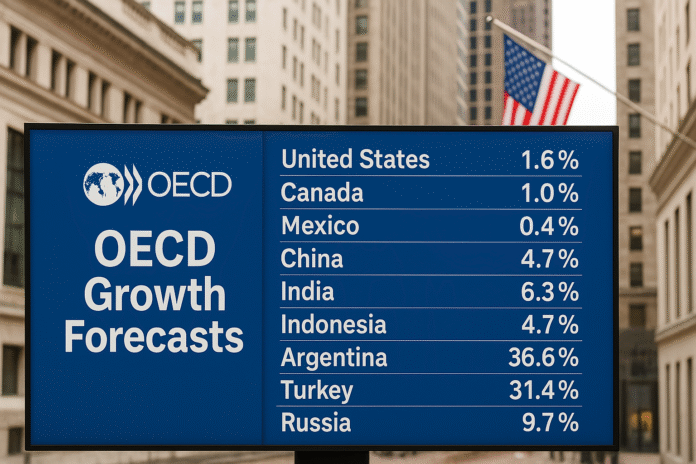
The report says that the United States will see one of the biggest slowdowns. U.S. growth is expected to drop from 2.8% in 2024 to just 1.6% in 2025 and 1.5% in 2026.
The OECD explains that this is mainly due to:
-
New tariffs that have raised the cost of imports
-
Retaliation from other countries on U.S. goods
-
Slower immigration
-
A shrinking U.S. government workforce
-
Uncertain government policies
Earlier this year, the OECD had predicted U.S. growth of 2.2% for 2025, but this has now been revised down due to these factors.
Canada, Mexico, China Also Affected
Other major economies will also grow more slowly:
-
Canada’s growth is expected to fall from 1.5% to 1% in 2025
-
Mexico’s growth may slow sharply from 1.5% to 0.4%
-
China’s growth will also dip from 5% in 2024 to 4.7% in 2025 and 4.3% in 2026.
China had faced heavy U.S. tariffs but recently saw some reductions, which may help soften the impact.
India to Lead Global Growth
While many countries are slowing down, India continues to stand out. The OECD expects India to grow by 6.3% in 2025 and 6.4% in 2026 — the highest among major economies.
Indonesia is also expected to do well, with growth of 4.7% in 2025 and 4.8% in 2026.
Inflation Still High in Some Countries
The OECD report says that inflation — the rise in prices — will remain high in some places.
-
The OECD group of countries is expected to have an average inflation rate of 4.2% in 2025.
-
Among the G20 countries:
-
Argentina is expected to see inflation of 36.6%, though this is much lower than 219.9% in 2024.
-
Turkey is expected to have 31.4% inflation (down from 58.5% in 2024).
-
Russia is forecast to have 9.7% inflation in 2025.
-
What Lies Ahead?
The OECD warns that the world economy faces many risks, and governments need to work together to manage these challenges. Countries should focus on smart spending, fair trade, and creating policies that help both businesses and people.
India’s strong growth outlook will continue to play an important role in the global economy. However, the global slowdown means India must be prepared for challenges in trade and exports.
For countries like the U.S., it will be important to manage the impact of tariffs and reduce policy uncertainty to avoid a bigger slowdown.
What Should Governments Do?
The OECD report also outlines key policy recommendations to help manage the risks of a global slowdown and support more resilient growth:
-
Lower trade barriers: Governments should work together to avoid raising new tariffs and reduce existing trade tensions. This would help prevent supply chain fragmentation and encourage global trade.
-
Support disinflation with cautious monetary policy: Central banks should stay alert in managing inflation. In economies where inflation is projected to moderate, gradual interest rate reductions can support growth, provided trade tensions do not worsen.
-
Reduce public debt: Many countries face growing fiscal pressures due to rising debt costs, military spending, climate-related investments, and ageing populations. The OECD urges governments to pursue fiscal reforms to keep public debt sustainable and preserve financial flexibility for future challenges.
-
Encourage business investment: To foster long-term growth, countries should promote policies that reduce policy uncertainty, enhance competition, lower entry barriers for businesses, and improve access to finance, particularly for innovation and intangible investments.
These policy steps, the OECD says, are essential to revitalise global growth, strengthen economic resilience, and avoid deeper stagnation in the coming years.
Source: OECD June 2025 Economic Outlook