





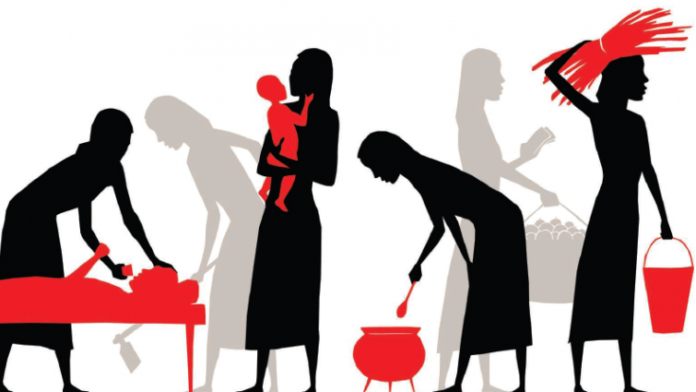

In a country where economic growth is celebrated, the backbone of every Indian household remains invisible—unpaid women’s labor. A recent survey has once again exposed the stark gender inequality in household work, where women bear the brunt of domestic responsibilities while men contribute only a fraction.
How Much More Do Women Work?
According to the survey:
Urban women spend 312 minutes (over 5 hours) daily on unpaid domestic work.
Rural women dedicate 291 minutes to household chores.
In contrast, men spend just 29-32 minutes a day on similar tasks.
This isn’t just a minor gap; it’s a glaring divide that reinforces the patriarchal mindset—housework is a woman’s duty, while men’s contribution remains optional.
The Price of Free Labor
From cooking to cleaning, childcare to elder care, women’s unpaid labor keeps families running. But does it count in economic terms? No. Women’s work doesn’t add to GDP. It doesn’t earn social recognition. Yet, if this unpaid work were monetized, it would contribute billions to the economy.
This isn’t just about household chores—it’s about women’s freedom. How many women can pursue education, jobs, or careers when their day is consumed by unpaid domestic work?
Who Will Change the Rules?
Despite repeated surveys and reports, no real policy action has been taken. Where are the government schemes recognizing domestic labor? Where are workplace policies that account for women’s dual burden? Instead, discussions about “women empowerment” remain empty rhetoric, while the burden on women continues.
A Call for Change
Household work isn’t just a “personal matter”—it’s a systemic issue.
Men must share responsibilities equally.
Domestic work must be acknowledged in economic policies.
Women should have the right to choose—not be forced into unpaid labor.
It’s time to stop romanticizing women’s sacrifice and start recognizing their labor, their rights, and their time. Because free labor isn’t love—it’s exploitation.